


First in Scotland to pilot accessible transport tech
West Lothian is the first area in Scotland to use cutting edge technology to help blind and partially-sighted people to access public transport.
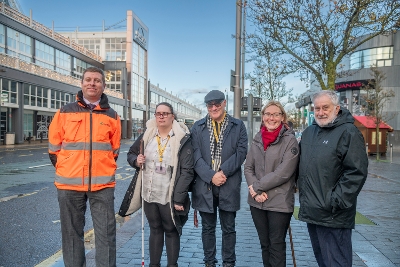
A pilot project between West Lothian Council, Lothian Country and Sight Scotland Veterans will help service users of the Linburn Centre with sight loss to access real-time public transport information to help them get to Livingston Shopping Centre and further afield.
West Lothian Council has installed new NaviLens codes at bus stops in Wilkieston and at Livingston Bus Terminal, following engagement with Sight Scotland Veterans on how their community access public transport. This engagement found that the use of apps employing AI was a key contributor in assisting users to undertake simple tasks, effectively making day-to-day life easier for them.
NaviLens codes are similar to interactive colourful QR codes, which blind or partially-sighted users can scan with their smartphones. This then provides users with real-time audio with transport information, such as buses services and the estimated times they will arrive at the stop. It can be used to provide information on local infrastructure, and facilities that surround them, making it easier for them to make their way around public places.
For more information on NaviLens, please visit www.navilens.com
Executive councillor for the environment and sustainability Tom Conn said: "We are delighted to be the first council area in Scotland to introduce cutting-edge NaviLens codes at our bus stops.
"The pilot scheme should improve access to public transport information for blind and partially sighted users, as well as the general public. Thanks to Sight Scotland Veterans and Lothian Country for working in partnership with us to make this possible."
The pilot provides an innovative and more cost-efficient means of communicating public transport information to users, replacing old technology that is no longer fit for purpose. It is hoped to roll out Navi lens codes to other key locations in West Lothian if the pilot scheme is successful.
Calum Welsh, Information Infrastructure Manager, Lothian Country said: "We were delighted to work with West Lothian Council and Sight Scotland Veterans to help to introduce NaviLens codes to bus stops as part of this pilot scheme.
"Promoting accessible travel information is a key priority for us and this project strengthens our commitment to enhancing the accessible customer experience across all aspects of our services."
Sight Scotland Veterans run the Linburn Centre in Wilkieston, a vibrant hub where veterans living with visual impairment can reconnect with others, rebuild confidence, and rediscover independence in a warm and welcoming environment.
Jason MacMillan, Assistive Technology Lead with Sight Scotland Veterans, added: "We are delighted that West Lothian Council has become the first council in Scotland to install NaviLens codes.
"They are colourful QR codes that not only give visually impaired travellers' instant access to real time public transport information via their smartphones, but they also guide them to the bus stop within 20 metres, which can be extremely helpful. This is a major step toward making travel more inclusive and independent for the veterans who use our Linburn Centre and for visually impaired people across West Lothian.
"NaviLens technology is designed to be easy to use, with high contrast codes that can be scanned from a distance without precise alignment, helping people quickly and confidently find accurate travel details. By working with West Lothian Council and Lothian Country, we are enabling our community to reach destinations like Livingston Shopping Centre and beyond with greater freedom.
"Our External Affairs and Campaigns team are keen to work with other councils across Scotland to support them to follow suit and make public transport truly accessible for everyone. This is a pilot programme, and we hope that our community can spread the word and help make it a success that can be rolled out in other places."


